
Southwest Colombia Trip Report
The following is a summary of my 2026 trip to southwest Colombia.
I first traveled to Colombia in 2012, making a productive scouting trip to the north where I've subsequently led annual trips. After falling in love with the landscapes and the people on that first visit, I've taken extra time each year to explore new areas of this tremendously biodiverse country. While traveling to several far flung places, searching for range-restricted endemics and seeing over 1100 of the country’s 2000 bird species, and getting a feel for Colombia's complicated biogeography, I was, of course, looking for the right ingredients to put together another birding and natural history trip.
It took a few years, but I finally put together a route in Central Colombia about 10 years ago, again falling in love with that amazing route. I had visited the Cali area many years ago, just before Araucana Lodge opened, and have always wanted to return. With the establishment of this great home base, the time has come to not only return but to put together a new trip to this biogeographically distinct region.
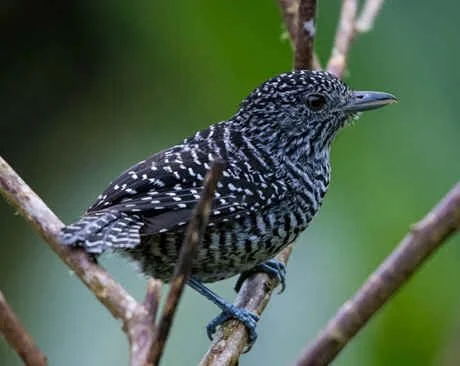
Bar-crested Antshrike by Lisa and Li Li
This route begins in Cali, the capital of the department of Valle del Cauca, which encompasses a section of the Western Andes, a portion of the Rio Cauca, and the lowlands of the Choco rainforest on the Pacific coast. As is often the case in Colombia, that’s a lot of biogeographical and habitat diversity packed into a small area. After arriving at the Cali airport, we stay at an adjacent airport hotel from where we make a short trip to our first destination, the Reserva Natural Laguna de Sonso, a large freshwater wetland along the banks and floodplain of the Rio Cauca. The Rio Cauca is one of several important biogeographic barriers in the Colombia, in this case being home to several endemic bird species as well as separating the Central from the Western Andean Cordilleras. In addition to the river edge and marshes, the Sonso area has floodplain forest and scrubby edges and is home to several hundred birds. The iconic bird of the area is the horned screamer, a large turkey-like wetland bird closely related to ducks and geese. While these noisy creatures are well-known from the banks of Amazonian rivers, there are two isolated populations that have mysteriously “escaped” (along with several other animals) to the Cali area and to west Ecuador. Along with more common species such as waders, gallinules, snail kite, yellow-headed caracara, cocoa and streak-headed woodcreepers, gray-cowled wood-rail, slaty spinetail, southern bentbill, and many more species, the area is also home to a few specialties such as the endemic grayish piculet and the uncommon ruby topaz hummingbird which feeds on exotic leonotus flowers from Africa. One of the other highlights are the large numbers of spectacled parrotlets. Like all other members of the genus Forpus, spectacled parrotlets are ridiculously cute. At the reserve, they can be seen extremely well as they nest in holes they’ve made in the ends of bamboo poles used to construct several of the visitor center buildings. They’re one of many birds along the route that no matter how many you’ve seen, you can’t “not look” every time!!
After a morning around the laguna, we board a covered boat and cruise along the Rio Cauca for about an hour to the charming Osprey Ecolodge. These days, it seems like every few months there is a new feeding station or ecolodge somewhere in Colombia with either a special ambiance, unusually good food, or specialty species….or all of the above. Osprey is one of those places. Along the river, we’ll likely find many of the species we saw at the laguna - waders, wattled jacana, kingfishers, cormorants, maybe an oversummering juvenile osprey - while looking for a couple of localized specialties from Amazonia, masked cardinal and oriole blackbird. We’ll have an excellent lunch at the lodge which, while it has many common and widespread species, also has many parrotlets and sometimes a day-roosting common potoo. We then head back down the river to the Sonso Reserve, spend a little more time looking for anything we may have missed, and return to our hotel for a break and dinner.
Narino Tapaculo by Lisa and Li Li
From the Cauca Valley at 3200 feet, we climb up to the eastern slope of Colombia’s Western Andes and the famous kilometer 18 road. The cloud forest here at 6500 feet is lush and rich with both widespread and range restricted species. The endemic Colombian chachalaca is joined by the widespread sickle-winged guan (whose blue facial skin appears and disappears as if my magic). Mixed flocks include montane foliage-gleaner, montane woodcreeper and many tanagers (multicolored, metallic-green, golden, beryl-spangled, and golden-naped), northern chestnut-breasted wrens skulk with gray-breasted wood-wrens and uniform antshrikes in the understory, and golden-headed quetzals are perched in fruiting trees. There are several feeding stations along the road, and we visit our first, Finca Alejandria (where we’ll also have lunch), in the afternoon. This is our first taste of an Andean feeding station in Colombia, and like so many others, it’s impressive. The hummingbird feeders are rather intense with activity and usually have ten to twelve species - white-booted racket-tail, brown violetear, crowned woodnymph, fawn-breasted brilliant, long-tailed syplh, white-necked jacobin, and occasionally the rare and localized blue-headed sapphire. The fruit feeders are a rainbow of color with the endemic multicolored tanager (and several other more common tanager species), southern emerald and crimson-rumped toucanets, black-winged saltator, red-headed barbet, black-billed thrush, euphonias, and more.
Perhaps the main highlight of our trip is our seven-night stay at Araucana Lodge. At 5250 feet, the lodge has perfect temperatures and is set in a quiet area with lush gardens. While much of the vegetation is non-native, they have productive feeders and some common edge species on the grounds. The rooms are beautiful and their food and service are first class. It makes the perfect home base from which to explore the regions biological riches.
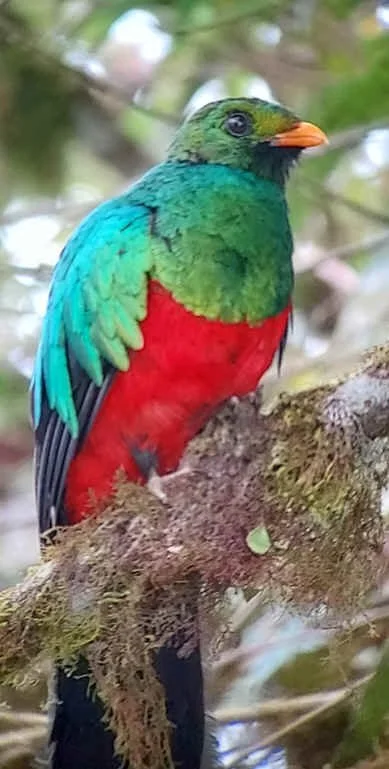
Golden-headed Quetzal by Misty Vaughn
On our first morning in the Western Andes, we head to La Florida, one of the most amazing “feeding stations” I’ve visited. Our hosts, Javier and Suelly, do a terrific job, and the bird diversity is impressive. They have a bug light, fruit feeders, banana feeders, and grain. Among the many highlights are chestnut wood-quail (one of many “easy to hear” but “very difficult to see” birds in the neotropics), white-naped and chestnut-capped brushfinches (coming to the bug light along with three warbler species - slate-throated redstart, three-striped warbler, and russet-crowned warbler), little tinamous coming to an afternoon grain feeder, and, at the fruit feeders, multicolored tanager, blue-winged mountain-tanager, black-capped and saffron-crowned tanagers, and crimson-rumped toucanet. La Florida’s “homemade” hummingbird feeders are a kaleidoscope of color and activity, and it can be a bit of a challenge knowing where to focus your attention. Between these feeders and those at Finca Alejandria, we can see up to eighteen species of hummingbird. La Florida also has a nice forest trail, and it’s a good place to see smoky-brown woodpecker, lineated foliage-gleaner, golden-winged manakin, red-faced spinetail, marble-faced and variegated bristle-tyrants, whiskered wren, white-winged becard, ashy-throated and common chlorospingus, golden-headed quetzal, and others. We can see, enjoy, and learn about as many as 70 species in what is always a memorable experience here.
Next up is Atuncela, a unique area of dry forest nestled in an odd rain shadow within the rugged Western Andes. With moist, green cloud forest on the hilltops above, the cacti, agaves, spiny legumes and totally different avifauna of this valley are a striking contrast to the habitats we encounter everywhere else on the trip. Our local guide, Anyelo, knows all the specialties and we enjoy his expertise during our morning here. among the many species we’ve seen are dwarf and dark-billed cuckoos, great antshrike, crested bobwhite, pearl kite, spot-breasted woodpecker, spectacled parrotlet, Pacific antwren, cinereous becard, mouse-colored tyrannulet, slate-headed and common tody-flycatchers, dull-colored and gray seedeaters, yellow oriole, apical flycatcher, orange-crowned euphonia, and ultramarine grosbeak. Atuncela is a great example of how geology and weather play a huge role is shaping plant and animal communities. What is always interesting to think about is how these species, some with vastly disjunct ranges, made it here to establish breeding populations. One such mystery is the ultramarine grosbeak which is primarily a bird of eastern Brazil and adjacent Argentina - how an isolated population came to become established on the other side of the continent (separated not only by Amazonia but also by the towering Andes) is fun to think about and presents one of those ecological questions whose answers are perhaps buried in the past.
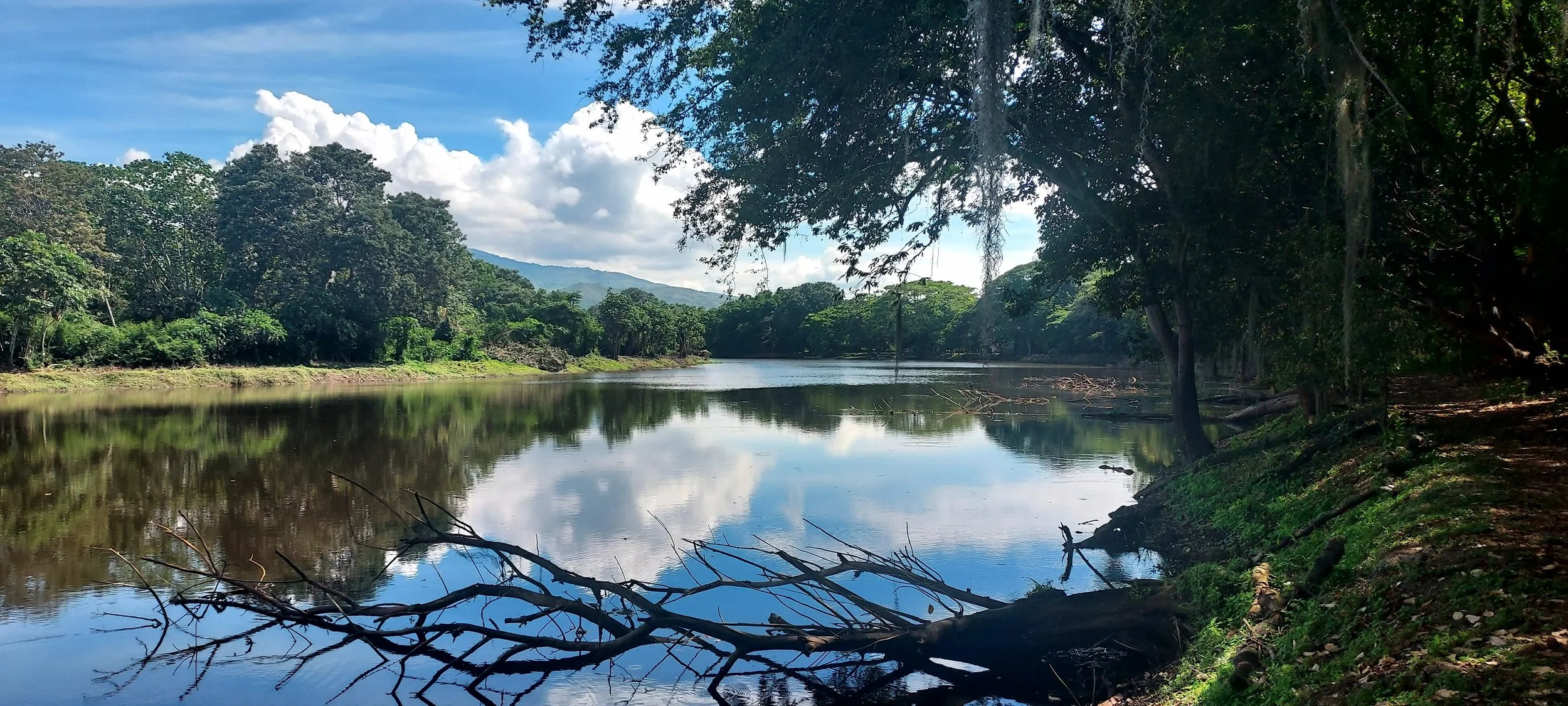
Laguna de Sonso
But wait, there’s more……lots more. What has become something of a well-known adventure in southwest Colombia is the day trip to San Cipriano, a small and isolated town in the the lowland rainforests of the Choco bioregion. “Choco” is the name of an indigenous group and a department (our equivalent of a state) in western Colombia. It runs the length of western Colombia and south into western Ecuador. The Choco covers an area of approximately 60,000 sq. km. (23,000 sq. miles) and holds a large number of range-restricted birds (about 60 species). Overall plant and wildlife diversity is rich. The Choco is characterized by wet forest, and indeed, with up to 5 - 8 meters (yes, meters!) of rain per year in some places, this is one of the wettest places on earth. The “adventure” portion of the trip involves a 25-minute ride on homemade carts, called “brujitas”, powered by attached motorcycles traveling along an old but functional train track that used to connect Cali to the port city of Buenaventura. The track passes through spectacular forest and is quite scenic. Once in San Cipriano, we’ll walk though town (where we might see cattle tyrant, gray-breasted martin, chesnut-headed and Baudo oropendolas, yellow-crowned tyrannulet, and band-rumped swifts) and to a well-forested road where we’ll spend the morning. Among the many birds possible here are several Choco endemics - Baudo guan, Baudo oropendola, stub-tailed and esmeraldas antbirds, scarlet-browed and blue-whiskered tanagers, rose-faced parrot, purple-chested hummingbird, black-hooded antthrush, Choco toucan, pale-mandibled aracari, five-colored barbet, and Choco elaenia. Other interesting species include speckled mourner, black-striped woodcreeper, many flocks of tawny-crested tanagers, purple honeycreeper, purple-throated fruitcrow, golden-collared and velvety manakins, white-ringed flycatcher, and black-breasted puffbird. The Rio Escalareta, which parallels the road, is one of the most beautiful neotropical rivers I’ve seen with its amazing glass-like water. We have lunch at a simple but nice restaurant “in the forest” and often see things from the table such as a nesting white-whiskered hermit. After boarding the “brujitas” for the trip back, we return to the comfort of Araucana in the late afternoon. It’s a special day.
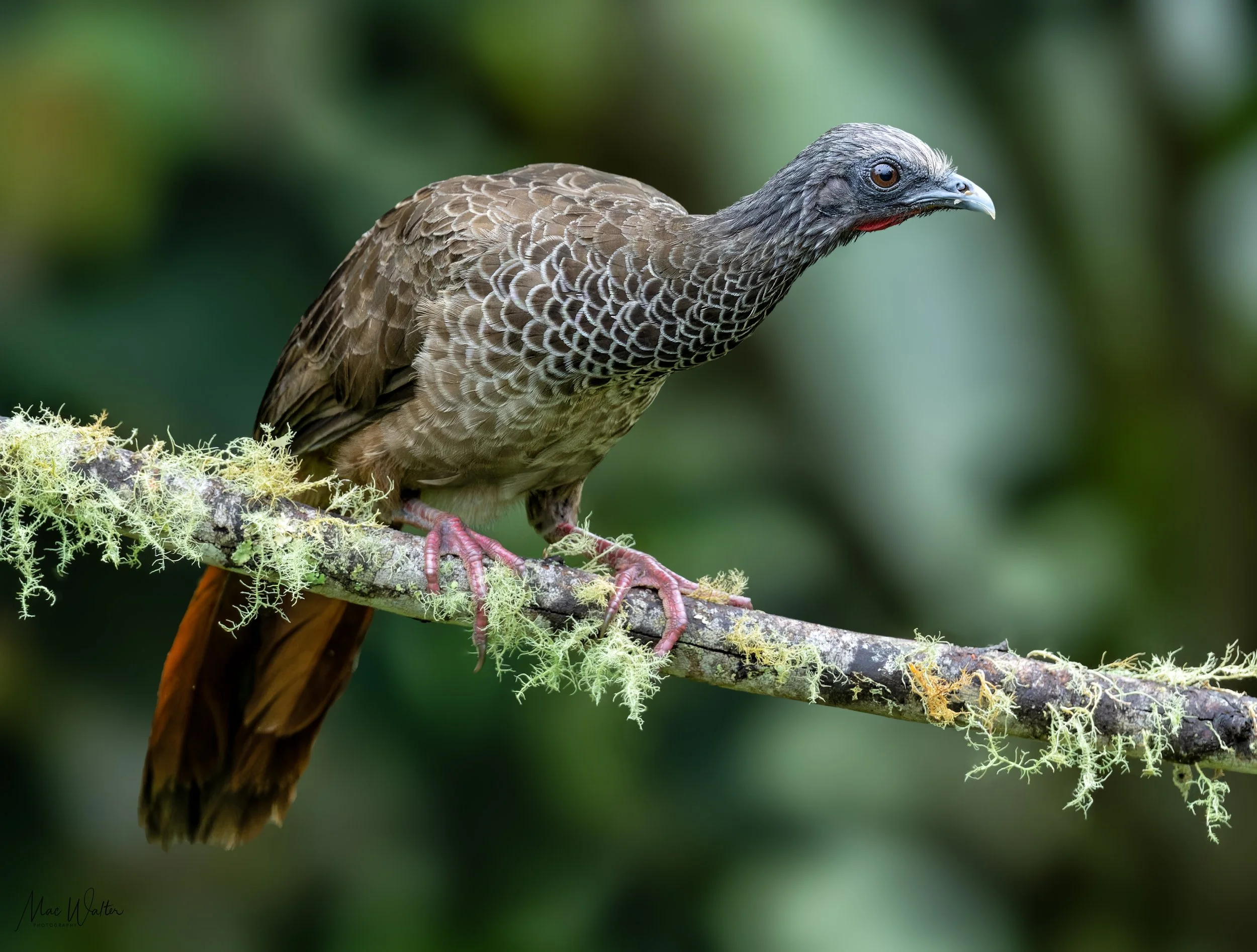
Colombian Chachalaca by Mac Walter
Yet another excellent day trip is to another well established spot, El Avistamiento de Aves Dona Dora. Dora Londono and her family started a simple roadside cafe, mainly for truck drivers going down into the Anchicaya Valley, in 1998. Surrounded by excellent forest with plenty of birds, it gradually became a stop for birders who realized the potential of the site. With the addition of hummingbird and fruit feeders, Dona Dora’s became a birding hotspot. today with a bug light, a habituated plain-backed antpitta (fingers crossed that it sticks around), and a nice quiet road to walk on, it’s a must on any visit to southwest Colombia. A number of Choco endemics can be found here - the highlight might be the toucan barbet, but other equally beautiful birds include purplish-mantled tanager, velvet-purple coronet, purple-bibbed whitetip, and empress brilliant. I’ve become a big fan of bug lights and am always eager to see what surprises show up in different forests at different elevations. Here, Zeledon’s antbird isn’t too surprising as I’ve seen it at other bug lights, but Pacific flatbill, sooty-headed wren, and flame-colored tanager were all firsts for me. Other birds we see here are green thorntail, spot-crowned barbet, uniform treehunter, lemon-browed flycatcher, lemon-spectacled tanager, swallow-tailed kite, and yet another suite of colorful tanagers (golden-hooded, rufous-throated, silver-throated, and bay-headed). Of course Dona Dora’s comes with an excellent lunch…..like just about every place we visit.
The last of the habitats we visit is the San Antonio cloud forest which takes us up to about 7000 feet. As is true anywhere on Earth, but especially in the Andes, you find different birds, often “replacement species”, at different elevations. In the San Antonio area we’ve found pale-eyed thrush, northern chestnut-breasted wren, tawny-bellied hermit, Narino tapaculo, barred becard, mountain elaenia, black flowerpiercer, and others.
The food throughout the trip is varied and very good. As many of you know, I'm a huge fan of foods native to the country that you're traveling in, and while southern Mexico remains my top spot for its long list of delicious native foods, the Andes of South America have their specialties, especially among the fruit juices. My favorites are tomate de arbol (tree tomato, which is indeed a Solanum), lulo (another Solanum), mora (a blackberry native to the mountains of Latin America), guayaba (guava), guanabana, maracuya (passionfruit), and araca (a cousin of guava).
Colombia is well known as Earth's most bird-rich country. With fascinating biogeography and wonderful people, it's becoming an ever more popular destination for nature-based travel. The level of service provided by local staff is some of the best I've encountered anywhere, and it's been a privilege to make many friends and have the pleasure of working with them. It's now become one of my favorite places in what I think of as my home away from home, Latin America. I'm excited about and greatly looking forward to sharing this new route with many of you next year !!